Sehr geehrte Damen und Herren,
vielen Dank für die rasche Lieferung der schönen Laterne Chilymes XQ-Y Bronze.
Ich habe diese Laterne gestern unmittelbar nach Erhalt der ersten defekten Laterne (xxx-xxxxxxx-xxxxxxxx) bestellt.
Ich hatte die Hoffnung, dass nicht alle Akkus in diesen Lampen tiefentladen sind.
Leider ist aber auch diese Laterne ohne Funktion. Auch dieser LiIon-Akku ist tiefentladen.
Der Akku hat noch eine Restspannung von weniger als 1.7 Volt. Der Akku darf nicht wieder
Aufgeladen werden, sondern muss entsorgt werden.
Da sich diese Fälle häufen, wollte ich herausfinden und messen, warum diese Tiefentladung entsteht.
Daher habe ich die Laterne extern mit 4V Spannung versorgt und den Stromfluß gemessen.
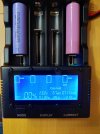
Bei der niedrigsten Leuchtstufe fließen 27.59 mA. Siehe beiliegendes Bild 1.
Das ist ein normaler Wert. Die Lampe ist nicht defekt.

Jetzt schalte ich den mechanischen Drehschalter aus. Nun sollte kein Strom mehr fließen.
Es fließen aber auch bei ausgeschalteter Lampe noch 0.092 mA! Siehe beiliegendes Bild 2.

Diesen Stand-by-Strom bezeichnet man als "prasitic drain". Er ist dafür verantwortlich, dass
der Akku auch bei ausgeschalteter Lampe langsam entladen wird.
Eine kurze Abschätzung:
der eingebaute Akku hat im Neuzustand (Lagerspannung ca. 3.4 - 3.7V) einen Ladestand von
ca. 35% seiner Kapazität. Bei den nominellen 2000 mAh hat er also eine Ladung von ca. 700 mAh.
Fließen nun dauerhaft 0.092 mA, dann ist der Akku nach einer Lagerdauer von
700mAh / 0.092mA = 7608 Stunden, sprich 317 Tagen komplett entladen.
Dies erklärt warum alle Lampen aus der selben Charge davon betroffen sind (siehe neueste Rezensionen).
Auch diesen Akku kann ich gern sicher entsorgen.
Eine teure Retoure und die damit verbundene umweltbelastende Entstehung von benutzter Ware
möchte ich gern vermeiden.
Mit freundlichen Grüßen
Onkel Otto
-------------------------------------------------------------------
Ladies and Gentlemen
Thank you for the prompt delivery of the beautiful Chilymes XQ-Y Bronze Lantern.
I ordered this lantern yesterday immediately after receiving the first defective lantern (xxx-xxxxxxx-xxxxxxxx).
I was hoping that not all the batteries in these lamps were deeply discharged.
Unfortunately, this lantern is also without function. This LiIon battery is also deeply discharged.
The battery still has a residual voltage of less than 1.7 volts. The battery must not be recharged and must be disposed of.
Since these cases are increasing, I wanted to find out and measure why this deep discharge occurs.
Therefore I supplied the lantern externally with 4V voltage and measured the current flow.
At the lowest light level, 27.59 mA flow. See attached picture 1. This is a normal value. The lamp is not defective.
Now I turn off the mechanical rotary switch. Now the current should no longer flow.
However, even when the lamp is switched off, 0.092 mA still flow! See attached picture 2.
This stand-by current is known as the 'parasitic drain'. He is responsible for the fact that the
battery is slowly discharged even when the lamp is switched off.
A quick estimate:
When new (storage voltage approx. 3.4 - 3.7V), the built-in rechargeable battery has a charge level of
approx. 35% of its capacity. So at the nominal 2000 mAh it has initialy a charge of around 700 mAh.
If 0.092 mA flow permanently, then the battery is completely discharged after a storage period of
700mAh / 0.092mA = 7608 hours, i.e. 317 days.
This explains why all lamps from the same batch are affected (see latest reviews).
I can also safely dispose of this battery.
I would like to avoid an expensive return and the associated environmentally harmful development of used goods.
Best regards
Onkel Otto


 .
.


 Laternen.